Our colleague, Daniel Teodorescu, CTO Arctic Stream – Cisco CCIE Enterprise Infrastructure expert and Cisco Certified Instructor (CCSI) – explains in this article how artificial intelligence is changing the way networking engineers work and why experience is becoming more valuable than ever. For those who want to explore the topic in greater depth, the extended version of the article will follow, with concrete examples from the Cisco and Palo Alto Networks portfolios.
Lately, we have all wondered whether AI will take our jobs. After years spent between SSH (Secure Shell) consoles, troubleshooting sessions at impossible hours and certifications earned through sleepless nights, from CCNA all the way to CCIE in Routing & Switching, Data Center or Security, our answer is reassuring and optimistic: no. AI does not replace us, but helps us eliminate repetitive and time-consuming activities, so that we can focus on what truly matters, such as analysis, decisions and solving complex problems.
AI proposes and the engineer decides
Today, an AI assistant generates a BGP (Border Gateway Protocol) configuration in ten seconds, goes through thousands of lines of logs and drafts the documentation we have been postponing for months. It is an extremely valuable tool, but its results must be validated by a specialist. AI does not know your peering policies, the history of the network or what happened the last time someone touched that route-map. A single incorrect line that reaches production means downtime, security breaches and incidents at midnight. Therefore, the basic principle in using AI is simple: many tasks are now done very easily with AI, but the results must always be validated by a specialist. At this stage, experience becomes essential and the engineer knows what to automate and what not to automate, implements rollback mechanisms and instantly recognizes when a generated result is wrong. Ultimately, a well-built automation represents technical experience translated into processes and code.
An example from the field: two solutions that did not communicate with each other
A familiar example for any network engineer is the situation in which the equipment inventory is managed in one platform, such as Cisco Catalyst Center, while the network documentation is kept in another solution, such as NetBox or an ITSM (IT Service Management) system. In this context, transferring and synchronizing data between the two platforms often involve manual, time-consuming and error-prone processes. With AI, this transfer becomes much easier. AI can perform this transfer by using a script that is run periodically.
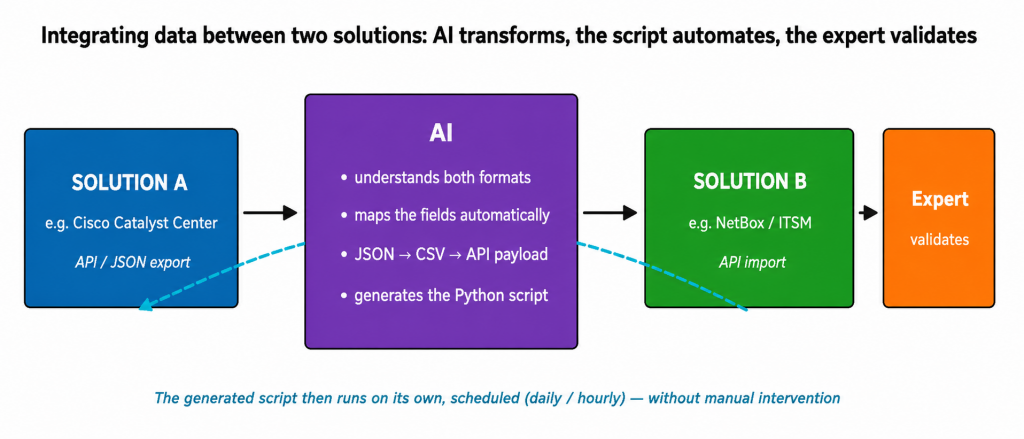
AI understands both formats, maps the fields and generates the script, which then runs on its own, on a schedule.
The engineer validates the script before implementation, checking the secure management of credentials, error handling and the use of read-only access where necessary and then schedules it to run daily. From that moment on, the two solutions remain synchronized without any manual intervention. This principle applies to any pair of solutions that expose an API or at least an export: monitoring and ticketing, firewall and inventory.
New generations: AI natives
Engineers at the beginning of their careers use AI naturally, just as we previously used the search engine: they learn protocols, build their labs and write their first scripts with an assistant by their side. This openness to new technologies brings energy and valuable perspectives to teams. At the same time, practical experience and a solid understanding of the fundamentals remain essential for validating results and making the right decisions. The best results appear in teams where the experience of senior specialists is complemented by the familiarity of the new generations with the use of AI-based tools.
How Arctic Stream can help you in the AI era
At Arctic Stream, we apply in our projects the principle according to which AI accelerates, while the expert validates. Our team, with expert-level certifications in Routing & Switching, Data Center and Security, can support you with:
- On-premises automation solutions: from assessing the network readiness level to complete pipelines with Ansible, Terraform and Python, integrated with existing management platforms.
- Automation in cloud and hybrid environments: SaaS management, SD-WAN and SASE, infrastructure as code and cloud API integration, for networks that extend beyond their own data center.
- AI architectures that scale: we design AI-ready infrastructures, from a pilot scenario to the entire organization, with Cisco and Palo Alto Networks solutions that grow along with your needs.
To discuss network automation opportunities and AI integration in your organization, we invite you to contact us at [email protected]. The Arctic Stream team can help you identify the right solutions for your infrastructure and objectives.