Gabriel Coman, Presales Manager at Arctic Stream, explains in this article how artificial intelligence is used in Cisco collaboration solutions, from features we already see in online meetings, such as background noise removal, transcription or real-time translation, to AI assistants integrated into Webex, Contact Center and videoconferencing equipment.

When we say “artificial intelligence”, we think of chatbots, generated images, robots that will take our jobs. However, many times we do not even notice AI. It is in the background and actively works for us. For example, it is the one that removes the dog barking from the background of the call, the one that automatically frames the speaker in the meeting room, or the one that automatically writes the meeting minutes while you are actually participating in the discussion or you are on vacation. It has been a decade since Cisco introduced AI elements into its collaboration products. The first official product that included AI in collaboration systems appeared in 2017 (Spark Assistant, later Webex Assistant). It all happened after Cisco Systems bought the startup MindMeld for its conversational AI technology, and in the same year launched the voice assistant under the name Spark Assistant (Cisco Spark was the name of the collaboration platform at the time, later renamed Webex).
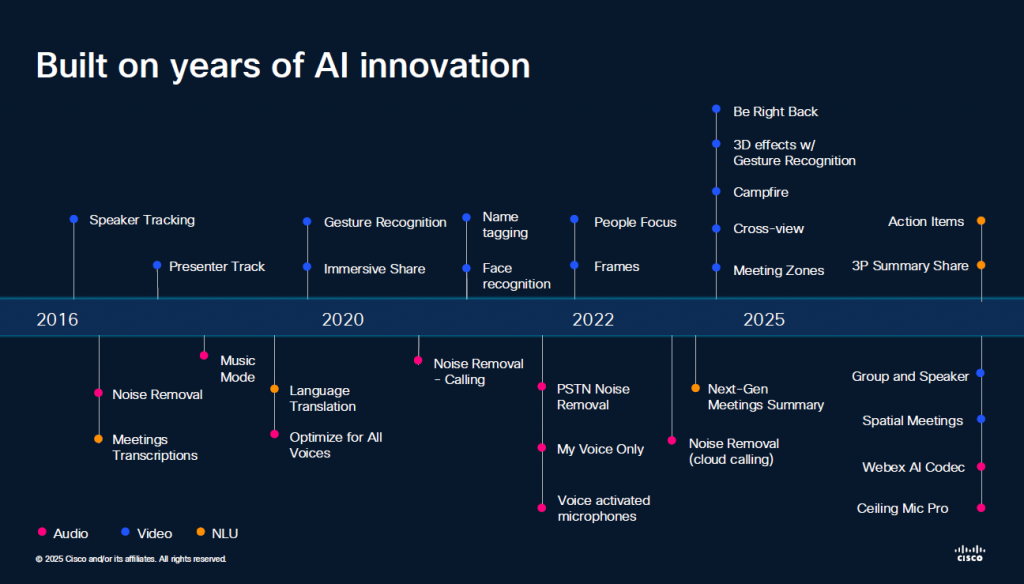
In 2018, the product was relaunched as Webex Assistant, the first enterprise voice assistant of this kind for the meeting room, with which users could control videoconferencing equipment by voice, check the room calendar, connect to online meetings and call colleagues from the company directory. Practically, it was an “Alexa” or a “Siri” for the boardroom, activated with the phrase “OK Webex“. The statement above, that Cisco has had a decade since it introduced AI elements into collaboration products, is not wrong, because Cisco had been using machine learning in Collaboration since 2016, when it launched the Speaker Tracking function used in TelePresence SpeakerTrack 60 systems.
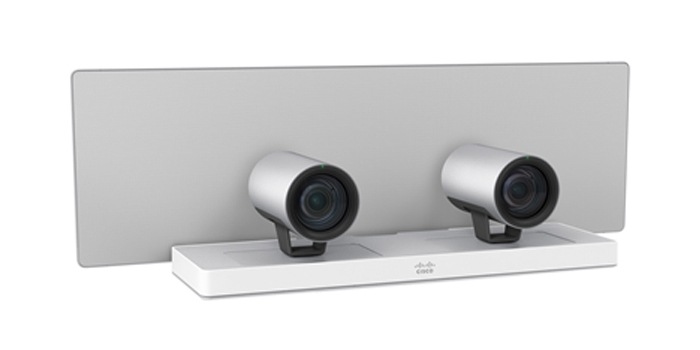
TelePresence SpeakerTrack 60 was an innovative 2-camera video system (it was, because it is no longer marketed at present). One of the cameras quickly located and displayed a close-up of the active speaker, while the second camera searched for and displayed the next active speaker, with a very fast switch between frames. The function that made this possible – Speaker Tracking – also used AI, only no one labeled it that way at the time. Both functions (Webex Assistant and Speaker Tracking) continue to be used in Cisco products, being developed and integrated into several Cisco collaboration products and with many current improvements. Cisco continued to develop new products and functionalities in the Collaboration area based on AI at all levels, the newest being Agentic AI, Virtual Receptionist, Real-Time Transcription and Translation, Translator Agent. All products are promoted by Cisco under the “Connected Intelligence” umbrella, and in what follows you will find a detailed description of the main Cisco AI-based functionalities that can bring real benefits in day-to-day work.
Video: www.youtube.com/watch?v=ZZLtqJVLuKc
Artificial intelligence in Cisco videoconferencing endpoints
Apart from Speaker Tracking, which we discussed above, Cisco videoconferencing endpoints and accessories also include other AI-based functions: Cinematic Meetings, Meeting Zones, Noise Removal, as well as AI Codec (an audio codec based on machine learning, which maintains voice quality on very weak networks), detailed below.
The Speaker Tracking function evolved from the TelePresence SpeakerTrack 60 system to a modern system based on fixed video cameras (QuadCamera) and optionally together with additional PTZ cameras, a system that offers several functions:
- Group view: automatically detects meeting participants and provides the ideal group framing for the best image
- Speaker view: uses a dedicated, integrated microphone array to detect and provide a prominent view of the active speaker
- Frames: captures a condensed view of the participants in the room and frames them individually or in smaller groups for more inclusive meetings, on Webex and when using meetings with external platforms.
- Dynamic mode: the system automatically chooses between group view, speaker view and frames to ensure the best image at any time during any meeting, automatically adapting the camera mode according to the number of people in the room and their dynamics
- Cinematic Meetings (cinematic view of the presenter and audience): intelligent framing and dynamic switching can be activated by combining Quad Camera with Camera Vision PTZ. Video: www.youtube.com/watch?v=IkGTeTBRq6c
- Meeting zones: the function is useful for defining virtual meeting perimeters, in order to capture and frame only the meeting participants in open spaces and rooms with glass walls. Practically, someone speaking outside the defined area will not be heard in conferences.
There is also artificial intelligence in the sound area. A series of AI-based functions are included in Cisco microphones, both in those integrated into videoconferencing endpoints and in external ones: noise removal, music mode, optimize for my voice, optimize for all voices. The Noise removal function eliminates background noises so that participants are not disturbed during online meetings. Noises such as typing, sirens, dogs barking, knocking at the door are detected and blocked automatically.
Video: www.webex.com/products/collaboration-ai.html
Cisco’s newest microphone, Ceiling Microphone Pro, incorporates the most audio functions based on AI:
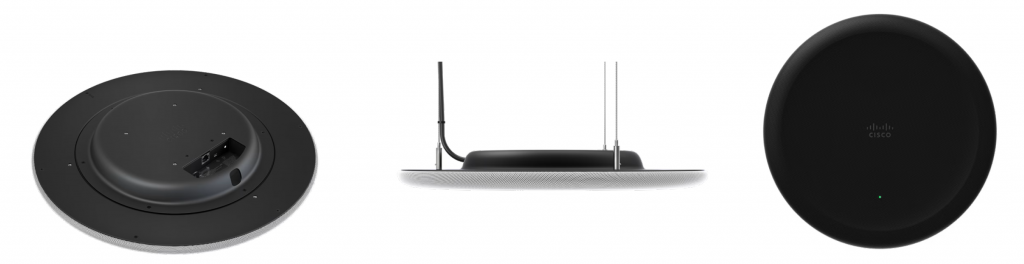
- Multidirectional, adaptive beamforming with a 64-element microphone array that feeds 8 self-adaptive beams that intelligently follow, focus on and capture the voices of active speakers, following the room dynamics and the changes in the workspace design
- Efficiently filters noise and reverberation from other directions, resulting in a high signal-to-noise ratio and an improved acoustic experience for remote participants
- The microphone’s integrated noise cancellation architecture and signal processing are augmented with AI noise removal and advanced audio processing from the connected Cisco video device
- Applies intelligent leveling, equalization and mixing of captured voices to enable natural sound for remote participants
- Provides audio triangulation for dynamic camera tracking in single-camera and multi-camera implementations, as well as in cinematic scenarios (cross-view, extended speaker view, presenter and audience)
All the AI-based functions above are provided by video components (cameras), audio (microphones), as well as codecs. The newest videoconferencing endpoints recently launched, Cisco Room Kit Pro G2 and Cisco Board Pro G3, include codecs based on NVIDIA chipsets for sophisticated image, sound and language processing in day-to-day meeting spaces.
Video: www.youtube.com/watch?v=ZZLtqJVLuKc
Artificial intelligence in Cisco collaboration applications (Webex)
Cisco’s collaboration application portfolio is complex. It is composed of applications for Meetings, Messaging, Calling, Contact Center, Vidcast, Polling, Webinars, Events, Whiteboarding plus the Webex Control Hub management component. Numerous AI-based functions have been developed in recent years, and some will be available in the coming period. Below are the main functionalities used in Cisco Webex collaboration applications.
AI Assistant for Webex Suite. The assistant generates summaries that users can return to during and after the meeting, even if the meeting is not recorded, while “Ask AI Assistant” allows questions about any work topic. There are also AI Notes for spontaneous (unscheduled) discussions, embedded analytics, multilingual captions and advanced voice isolation that separates speakers even in noisy environments. It works for the Messaging, Meetings and Webex Calling applications, all managed from Control Hub. Cisco AI Assistant is used even in Formula 1!
AI Assistant for Webex Contact Center . It includes AI-generated summaries (summary of dropped calls, summary of transfers from the virtual agent), real-time transcription, real-time assistance, detection of agent burnout, automatic customer satisfaction score and sentiment analysis.
AI Routing for Webex Contact Center. It uses advanced artificial intelligence and real-time data, including customer context, sentiment, agent information and the communication channel, to route each request to the most suitable agent, accelerating case resolution and improving results.
AI Receptionist for Webex Calling. It is an always-available virtual assistant that automates routine tasks: answers calls, answers questions, schedules meetings and transfers calls.
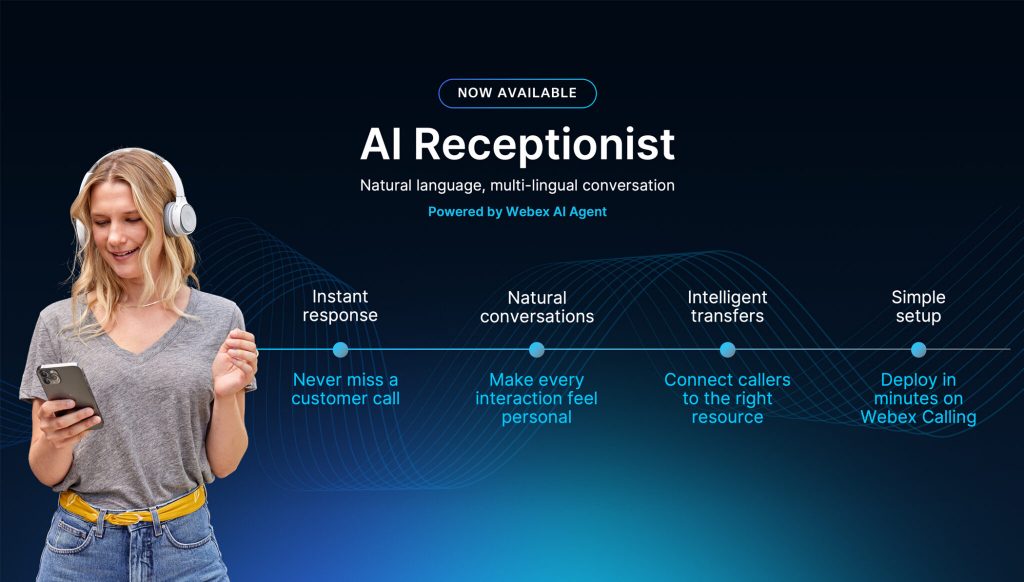
Video: www.webex.com/us/en/products/suite/enterprise-cloud-calling/ai-receptionist-webex-calling.html
Task agent. An AI agent proactively generates action items from meeting transcripts, reducing the need for manual follow-ups.
Notetaker agent. An AI agent can transcribe and summarize meetings in real time, in order to capture the value of spontaneous discussions and brainstorming sessions. This agent is available in the Webex application and on Cisco Collaboration devices.
Polling agent. An AI agent proactively recommends live polls during meetings, to stimulate engagement and capture real-time feedback from participants.
Meeting scheduler. When meetings need to be scheduled, this AI agent automatically identifies the need for a follow-up, finds common availability and proposes scheduling.
Real-time translation in Webex Meetings and Webinars. Real-time translation enables more inclusive and engaging meetings and webinars. The 16 spoken languages available for a meeting or webinar can be translated into more than 100 other languages through closed captions, with the real-time translation license. When real-time translation is activated, the system automatically translates a person’s speech into captions that appear above the meeting or webinar controls.
Webex Control Hub. Webex Control Hub is the centralized place for managing Webex applications and application users. It provides unified administration with usage insights, policy enforcement and real-time diagnostics enhanced with AI-guided troubleshooting.
The future of collaboration: AI agents and translator agent
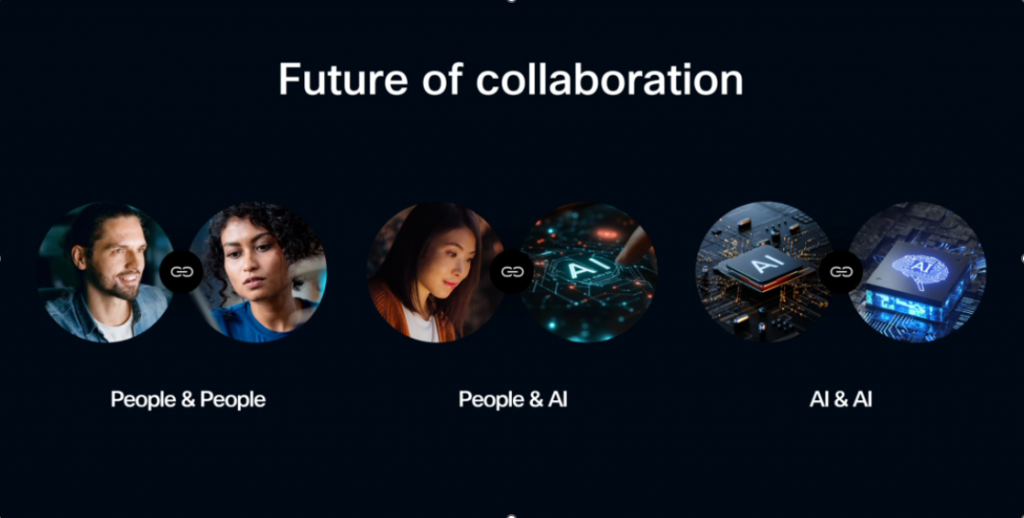
Agentic AI is the next evolution of AI innovation. A world in which AI can anticipate problems before they occur. Whether it is troubleshooting issues in a conference room before an important meeting, or a utility company detecting a localized power outage before it spreads, AI proactively sends notifications to affected customers, guiding them regarding safety measures and the estimated restoration time, thus preventing a wave of emergency calls and ensuring a fluid and well-informed response. A world in which AI can free the employee from hours of repetitive and monotonous tasks, allowing them to focus on strategic problems, supported by intelligent information and creative tools. This vision is already taking shape in the day-to-day activity of organizations, through AI agents dedicated to each department, such as those mentioned below.
Contact Center
AI agents redefine the way Contact Centers manage call volume. By replacing traditional IVR systems, rigid and frustrating for customers, a conversational AI agent can understand the caller’s real intent from the first seconds and route them correctly, without endless keypress menus. In parallel, call deflection capability reduces the pressure on human agents, automatically resolving simple and repetitive requests, so that teams can focus on cases that truly require human intervention. Bidirectional notifications complete the experience, allowing customers not only to receive information, but also to respond and actively interact with the system.
Sales & Service
In sales and customer service, a well-integrated AI agent becomes a permanently available consultant. Connected to the company’s knowledge base, it can provide instant and correct answers to customers’ questions, without waiting times. Automatic lead qualification helps sales teams focus their efforts on truly valuable opportunities, eliminating time wasted with unsuitable potential customers. At the same time, automatic appointment booking simplifies a process that, traditionally, involves many exchanges of messages and calls.
HR
Human resources departments can use AI agents to transform the employee experience from the very first contact with the organization. The process of integrating new employees (Onboarding) becomes faster and more personalized, guiding them through the necessary steps without overloading the HR team. Frequently asked questions about benefits, from medical insurance to vacation days, can be resolved instantly, 24/7.
IT
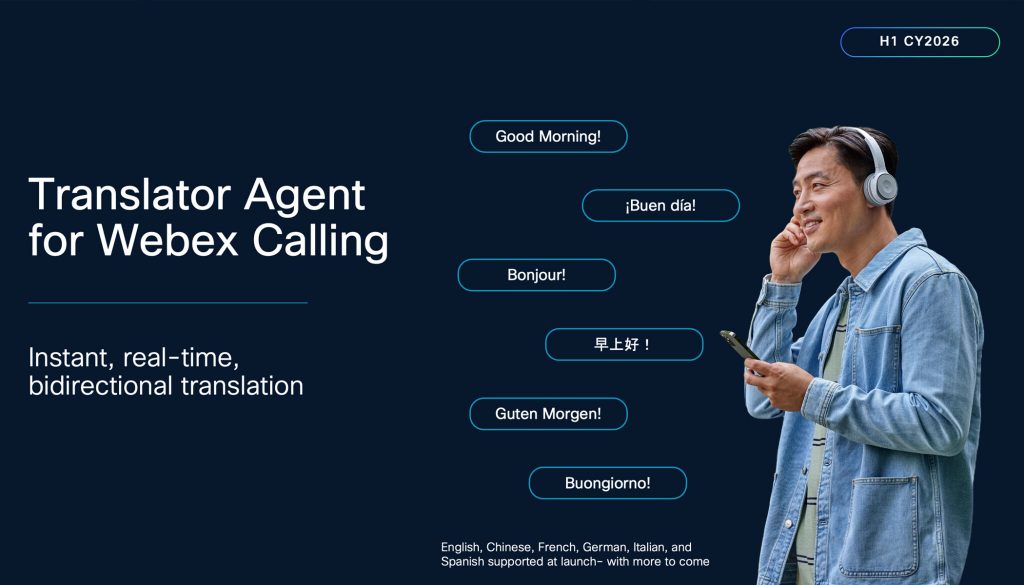
For IT departments, an AI agent functions as an always-available first level of support. It can provide ticket status in real time and, in many cases, can propose the direct resolution of frequent problems, without the need for a technician’s intervention. Proactive updates anticipate users’ needs, signaling necessary upgrades before they become problems, while automatic notifications for training sessions ensure that teams stay up to date with internal tools and processes. Webex Translator Agent, announced at Cisco Live EMEA 2026 with an estimated launch in July 2026, provides real-time speech-to-speech translation for Webex Meetings, Calling and Contact Center applications. The translation preserves the speaker’s voice, tone, cadence and intonation. The solution eliminates language barriers: for example, a sales director from London speaks English, while the client in Madrid hears their voice in Spanish, with the enthusiasm intact.
Video: www.youtube.com/watch?v=B51qKRsDmag
Across all industries, multilingual interactions are becoming increasingly time-sensitive and increasingly valuable. Traditional approaches, such as hiring multilingual staff or using interpreters, are costly and difficult to scale. Translator Agent eliminates these barriers, enabling organizations to provide faster and more inclusive services, using the same well-trained teams they already have. Translator Agent will support English, French, German, Hindi, Italian, Japanese, Korean, Mandarin, Portuguese and Spanish, available at launch, with additional languages to be added later. It will initially be available for Webex Calling, with support for Webex Meetings and Webex Contact Center to be added later.
At the most recent event, Live US at the beginning of June 2026, Cisco announced other AI-based features for Webex Contact Center: AI WEM, AI Concierge, and AI Agent 360.
AI WEM
Cisco describes the solution as a complete rebuild of workforce management tools, designed specifically for environments where human agents and AI agents coexist. The suite covers forecasting, planning, quality management, performance dashboards, real-time agent guidance, and AI-powered onboarding. Each capability works for both human agents and AI agents — an aspect that Cisco strongly emphasizes, considering that most traditional WEM tools were built for a world where every agent was human and every evaluation was manual and performed through sampling.
AI Concierge
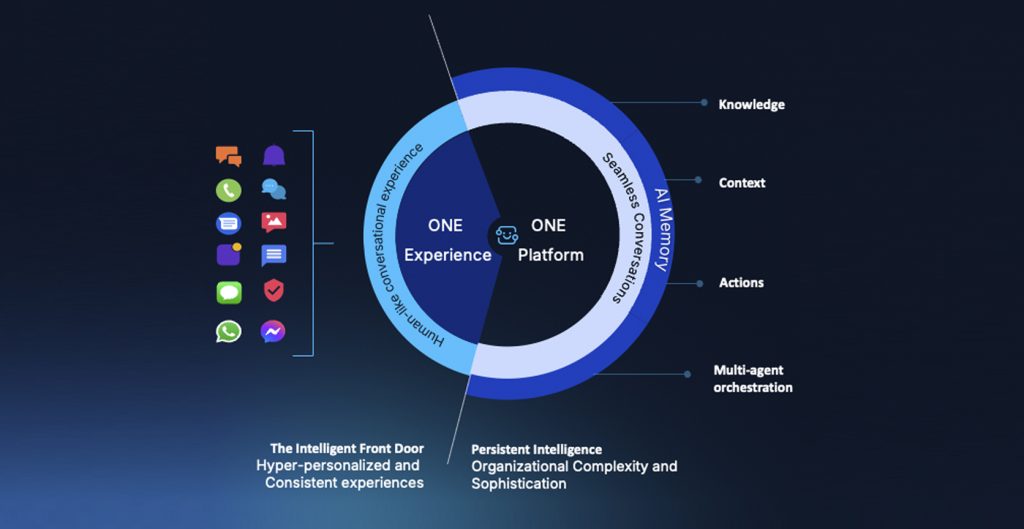
Cisco also launched AI Concierge, a pre-built AI agent designed to act as a company’s first point of contact, orchestrating between knowledge bases, other AI agents, and enterprise systems in order to deliver what Cisco describes as a continuous, hyper-personalized conversation. The product is built around persistent memory, which means that, regardless of the channel, moment, or number of handoffs, each interaction should feel like a continuation of the previous one.
AI Agent 360
AI Agent 360 is Cisco’s answer to the growing concern related to AI agents operating without sufficient oversight. The solution brings together Cisco’s AI observability, security, and management capabilities into a single control plane, covering the entire agent lifecycle. The product is based on Cisco AI Defense for customized security protections (guardrailing) and on the Splunk portfolio for large-scale observability.
In October 2026, Cisco WebexOne 2026 will take place, where, as Cisco has accustomed us, it will announce a lot of news in the collaboration, endpoints and, of course, AI area (because in 2026 there is no tech or non-tech event where AI is not discussed). We hope they do not launch an AI agent that writes articles instead of us! 😊 We are keeping an eye on the stage and will keep you updated! For more details, you can contact us at: [email protected].